Showing posts with label hose. Show all posts

Sunday, 16 September 2012

Special Edition: Getting Wet


GETTING WET&CLEAN:
 
What better way to relieve boredom for 'hot and bothered by flies' horses, than to get the hose out, attach a gentle sprinkler end, grab the shampoo and get everyone absolutely soaking wet!

Including myself.


Remember Shelley's first Law of Grub Transferance: Grub is neither lost nor created, merely transfered from horse to his butler...ME!

So, after all the scratching and rubbing from those pesky midges and biting mosquito's, I can give some fleeting relief to those boys with some medicated horse shampoo and a complete soaking.  I can wet them all, but I do their heads by hand, never a hose and never shampoo, just incase it's gets in their eyes.


I use a special tentacle covered sponge (noodle sponge BUT not a pink one!), and add the shampoo to the water, never directly onto the horse, it would take forever to completely rinse out any soap added to their coats directly, and I absolutely MUST get all the suds out, it's better for their skin that way.


I rub the coats all over with the soapy sponge including their manes and sheath area,  their tails I do separately because they often need a good scrub.


Then I hose them off very very carefully, I make certain all the soap is out of their coats and away from their skin.  And their coats will be shiny and clean.


I sweat scrape the most of the water off their bodies then leave them standing in the sunshine whilst I towel them off.  I wipe over their faces and around their ears with the rinsed sponge and wipe their eyes and nose with just clean water and a flannel.


I brush through their manes and tails with a hairbrush being careful not to break any hairs,  then I go over their already drying bodies with a very soft brush I bought specially for their faces.


An hour later, the boys are clean and no longer worried by the flies,  they smell gorgeous and clean and they shine very brightly.

Henry's mud fever is almost completely gone, and since all I have been doing is applying creams and scrubs to the area since he got it, it felt very nice to wash the area completely of any residue.  The pastern is now clean and healthy looking.

Tom loves his chest washed, the little midges queue up to bite him there and it must be a relief to finally get rid of them, if only for a short time.

The boys have a great time, and then the go out and roll, and that's when all the pleasured grunting begins, then there's squealing and usually galloping too.


Sunday, 5 August 2012

TCJ77 Mud Fever: Part Three


TCJ31 FURTHER TO MY UPDATE:
To be suffering with mud fever in August...via a very wet June & July does seem a little ludicrous doesn't it?  But here we are, and Henry has mud fever around his left fore pastern.


This is what Horse & Hound say about managing it from 2008+9 (don't worry, mud fever hasn't changed since then!).  I regularly consult the H&H vet pages, it's brilliant.

10 ways to manage mud fever:

21 April 2008

Mud fever is a general term for a skin infection around the heels and pastern of a horse. It is also frequently called “greasy heels” or “cracked heels” and is caused by an infectious agent called dermatophilus congolensis, which loves muddy wet conditions.

The infection can stay dormant in the skin, becoming active when the skin is compromised in some way, usually by prolonged wetting.

Spores germinate to produce hyphae (threadlike tentacles) that penetrate into the living skin and spread in all directions from the original site. The result is an acute inflammatory reaction. **it only needs to be a tiny break in the skin surface therefore to let this nasty in.

Often the disease is made worse by a secondary infection. Classically there will be serum oozing from the skin, causing the hairs to stick together.

There are often crusty scabs on the skin surface that, if pulled off, will reveal a greeny-yellow pus with the protruding hair resembling paint brushes.  

Mud fever can be extremely painful to touch, especially if secondary infection is present, but is rarely itchy.

Frequently more than one limb is affected.

In severe cases, the whole limb may swell up and a secondary lymphangitis can develop. This is serious and requires intensive veterinary treatment usually including both intravenous antibiotics and anti-inflammatories.
**This is what Henry had, very nasty indeed, and that's why I'm a fanatic now.

Karen Coumbe MRCVS
8 January, 2009
While there is no magic cure for mud fever, there are certain steps you can take to minimise the detrimental effects to your horse's health:

1. Where possible eliminate any recognisable triggering factors such as mud or mites, so consult your vet to obtain an accurate diagnosis and proper treatment plan.

2. Stable the horse on clean bedding and provide good living conditions.

3. Carefully clip (not shave) the affected area, so that air can get to it and allow it to dry.

4. Remove the scabs. A suitable antiseptic wash (like chorhexidine) and warm water is best to reduce infection. Your vet may need to sedate the horse to do this effectively.
**I use Hibiscrub on mine, SR

5. Carefully dry the area — use clean towels or a hairdryer with a circuit breaker — to prevent the skin remaining wet and waterlogged.

6. A variety of ointments, lotions and potions are available to use as an emollient to maintain hydration of the skin. Again your vet should be consulted as to what is best for your own horse.
**for a bad case where your horse is lame, he'll need antibiotics from your vet and some anti-inflammatory (equipalazone).

7. Remove all scabs and debris and ensure the stable is properly disinfected. Keep the horse in or turn out on to a manège or well-drained, dry field.

8. If there are deep heel cracks or big open sores, they should be dressed with a non-stick dressing and cotton wool or gamgee, otherwise leave the legs unbandaged to allow the area to breathe; bugs flourish in damp areas, so do everything you can to keep the limbs warm and dry.
**I have successfully used hoof-boots over these dressings so Tom & Henry can go about their usual routine.


9. Severe cases with obvious infection CALL YOUR VET, your horse may need a long course of antibiotics, which needs to be continued for seven to 10 days after the soreness has abated. Your vet may also prescribe anti-inflammatory drugs such as bute to reduce the pain and swelling.
**This what happened to Henry, he has a swollen leg for over 2 weeks, it was horrible.

10.Make sure your horse has been protected against tetanus.

Henry:  this time began when he lost a shoe in July and his hoof boot rubbed him a little, you wouldn't even have noticed it, but it was enough for that nasty infection to take it's hold on my boy once again. 

Well, I'm not standing for it this time. 

I have washed the area until Henry can't stand it anymore, I used a hose to soften the crusty bits and as I dried the area thoroughly, the scabs came loose.  I dried it more, all the while administering treats, and applied an after lotion I bought on-line for mud fever: MUD MARVEL.  It isn't cheap, but it does the job.

In a few days, Henry's skin that straight after I've just done the first-aid bit above, looks red, sore and angry, will fade, go pale and dry up completely.

I think we're all going to have to get used to these climate changes, and prepare for flies in the winter and mud fever in the summer, always a good idea therefore to have your first aid and lotions and potions cupboard fully stocked, because you never know now when you might need what used to be seasonal applications.

Here I have wrapped the pastern in a bandage with a liberal application of wound cream and a dressing on top.  The bandage does the trick to keep the area moist and clean as well as keeping the flies away, we don't have to worry about this in winter...mud fever in summer is a different matter!

This stays on for a few days whilst the area becomes pale and then Henry will go without any topical applications to clear it up completely.  The bandage also has the added bonus of helping any swelling to go down, leaving Henry free to gallop around with Tom.


Saturday, 25 February 2012

TCJp33 Life after Mud fever: Part Two


SPRING12: ....and Henry is clearly feeling better!


We unashamedly take quite a few photos of Tom & Henry, today 25 February, the boys went back out to grass after winter (well the 2 weeks of winter we had here anyway).


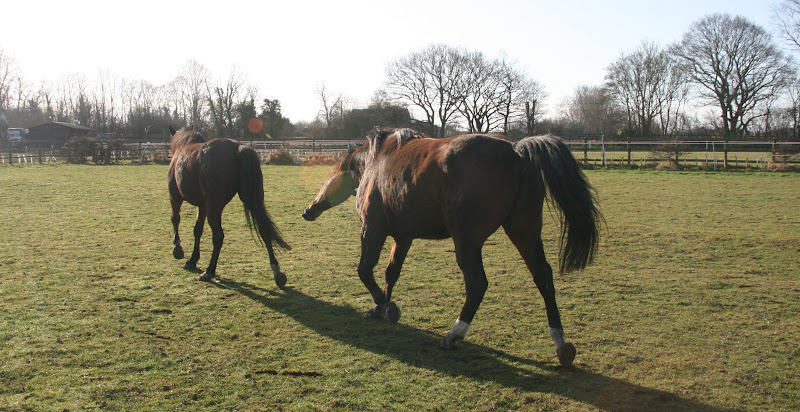
As you can see from the pictures, they thought letting them out to grass finally was a brilliant idea.  The pasture has recovered very well and the grass is already growing.  I wonder if it will be able to keep up with the munching!?  Henry has all but recovered from his bout of mudfever, and all this extra excersise can only help.  The land is quite dry too.


I will take him for a short ride tomorrow and see or rather feel how he is.

BUT: grass is todays important message........So this is how the morning developed....and unusually, Tom started it all!!!


You can easily see from this sequence how Tom could unseat me.


Yes, Henry is definitely feeling better.  swelling down, heat gone...all good.
Mud Fever:  there is life afterwards.


ooooooooooooooooooooooohhhh, those itchy bits...


Tom's coat is coming out thick and fast.


I think I'll just stay down here a minute for a little nap, all this galloping about does take it out of one!  Butler!!! where's my back rub!!


Don't worry.....I've got it.....


This is their chewed 'horse-ball', a subtle sign the boys wanted out!


So there it is....expect I'll see the boys sometime on Tuesday!