Showing posts with label handy equipment. Show all posts

Sunday, 29 January 2012

TCJp27 Equipment update: Hoof Boots


HOOF BOOTS:
...a very handy addition to the tackroom.


Henry quite regularly throws a shoe, it's got Steve stumped because he shoes Tom exactly the same way, and to my recollection Tom has only ever lost one twice.  But Henry 'flings' himself about, often spinning completely around on his back legs, so suspect this is how he does it!  

Because Trakehners have shallow feet, being shoeless is not suitable for our gravely ground here in WW, otherwise Tom & Henry would definitely go barefoot.

So, Henry limps about on a sore foot once his shoe is gone, which naturally I cannot bear.

Twas then, I read an article in a Horse magazine about a long distance rider who's Arab goes barefoot, and successfully uses Hoof Boots.  Ahhh thinks I.  Hoof Boots might be the answer.

I went straight to the saddlery with the feet dimensions John had measured for me and bought the one Hoof Boot they had in stock in Henry's size.  It worked well, but has already started coming apart.  Washing the boots has made the Velcro split apart, so it now cant be secure.

So, I went into major research mode:  to find the perfect boots, and as John mentioned, get ones also suitable to fit with a poultice for emergencies as well (John is very sensible, because gaffa tape works well to keep poultices in place, but it wears out).

Here's what I discovered, just in case you find yourself needing these in your inventory (I recommend that you do, you never know, and these things are designed for riding in so they are very tough):


Firstly, measure the foot, the full length including the bulbs or 'butresses' of the foot and the width at the widest part.


Then check the individual product sizes, there are many, once you've decided on the brand you want.. Remember some you'll want with 'ankle' pastern length part so they can go out in the mud, and be protected.


Top Tip: Wrap the clean hoof in clingfilm first, in case the boot doesn't fit, you can return it clean.  This was my favourite boot above for Tom & Henry, the 'EasyBoot'.

Well made and goes on and comes off easily too, which is important if your horse is fidgety.

Here's how you measure up:


And for use with the poultices: the 'Carvello Boot'


Harder to get on and off, but has room for the bandage or poultice inside.  Fit with the fittings outside so you don't have to climb underneath your horse to do them up!
Here's how you measure up for the Carvello:


Tom & Henry 'plonked' around the yard first of all, and don't expect your horse to do any lightweight tricky movements in them, they are plonky, wide and heavy.  BUT for emergencies, they are brilliant.


Taking them off is easy, just pull them off from the back in the same motion your farrier uses to get shoes off.

I will get a lot of use out of these, especially with Henry.

Friday, 2 September 2011

THE EVIL AMONGST US: RAGWORT


Common Ragwort: Senecio Jacobaea


Above: the pretty yellow daisies of the plant, and below at 'rosette' stage.
THIS PLANT IS POISONOUS AND MUST BE KILLED


DEFRA: How to identify Ragwort

All times of the year we must be vigilant in our own fields to dig up and destroy this plant.  The damage it causes, the suffering to horses with irreversible liver damage, who have ingested the weed and the ultimate death of some horses too is just too horrible to bear. Whether it's your own land or not, whether it's your legal responsibility or not, you have a duty of care to your horse, if he's grazing around this weed, get in there yourself with a rag-fork and dig these plants up, please, don't wait for someone else to get round to it.  It might be too late.

Most horses will graze carefully around the weed, until they run out of grass.  It is especially palatable dried in hay, so be extra careful where your hay comes from.  See the field before it's cut if possible just to be certain.

Ragwort is an "injurious weed" and is governed by the Control of Weeds Act 1959.


Enforcing the Weeds Act form:


A new Ragwort Control Act 2003 amends the Weeds Act, giving added protection to horses. The Ragwort Control Act makes it easier to prosecute those who disregard the need to control Ragwort.    

Defra have a Code of Practice which offers comprehensive guidance and advice on all matters to do with Ragwort, and it's clear from all agencies that a landowner must treat land infested by ragwort.


The Code of Practice: DEFRA


However, if you see horses grazing in a field with ragwort growing in it, the lines of enquiry gets a little fuzzy, since no one takes responsibility for the prevention, only the prosecution.

I spent all morning on the phone just trying to get someone interested in 2 horses near me grazing around plants waist high in their field.  They have since been moved off the land - phew!  The RSPCA will of course investigate ruthlessly any horse suffering with obvious signs of poisoning, (too late in my view) and Natural England will act if the land is public.  DEFRA tell me it is not illegal to have the weed on land, but you can fill in a form to report the sighting.  The problem is that if you dont know who owns the land they will not help so you're on you're own again! 


You can download the form from DEFRA's website.


So where does someone go when nobody wants to do anything unless someone is already breaking the law?  The answer for me turned out to be the brilliant BHS!!  They pledged to send a local rep to visit the site and try to speak to the landowner, and the horses were moved that week - well whoever went, likely saved those horses lives. thank you.

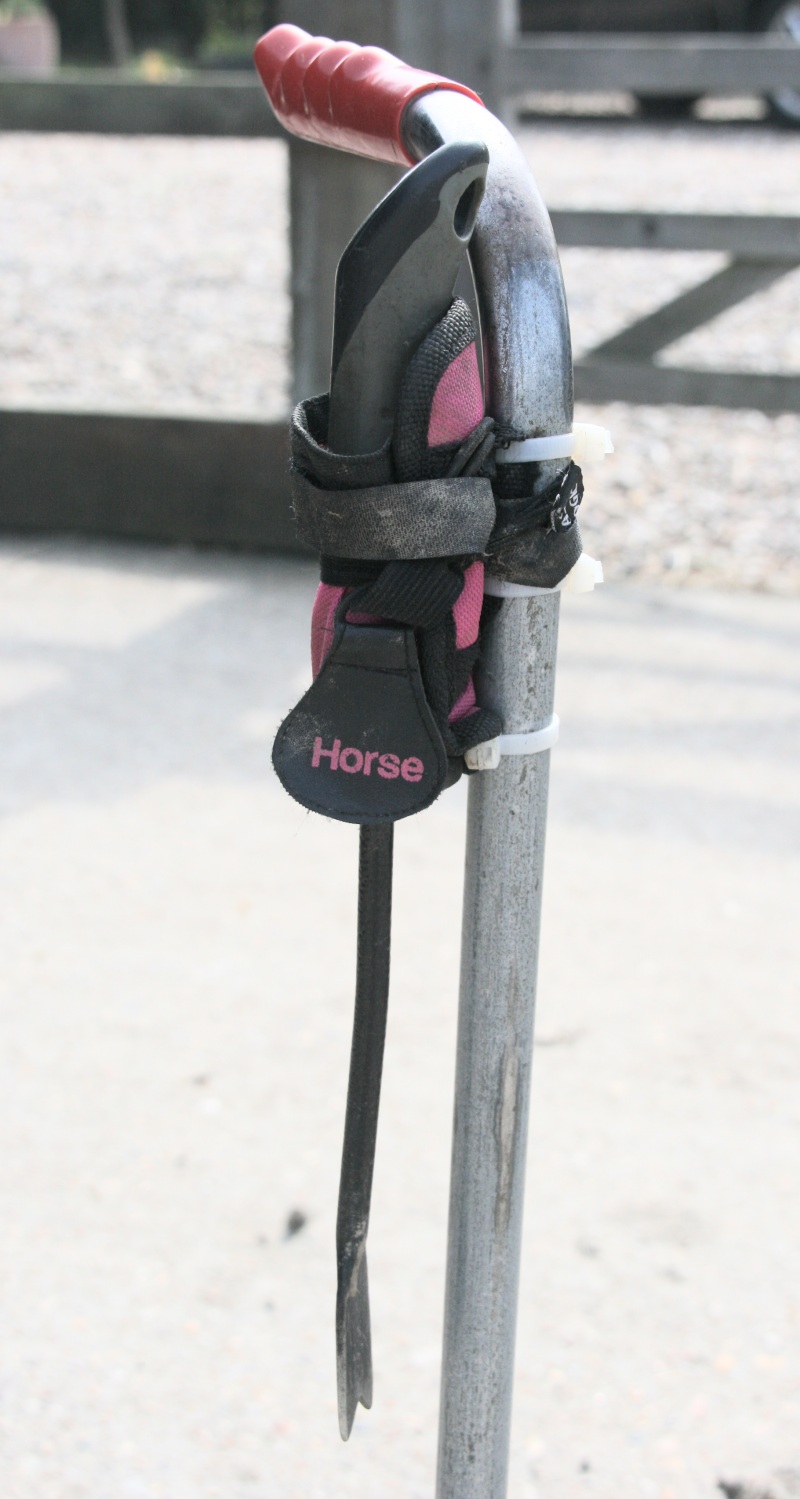
Personally I'm a rag-fiend, and dig up the evil little perishers wherever I see them, in fact many a curly leaved dandelion has lost it's life to my rag-dig!  John has 'invented' a cunning little device everyone of us can have: it's a weed puller (The normal two pronged fork that I have dotted in safe locations all around my land), and he's attached it to the handle of my poo-picker (using an old HORSE magazine mobile phone holder). It means I can dig them up every day when I poo pick, and because I'm super vigilant this way, I get them at rosette stage (often tiny), and they're easy to get up. So poo-pick and rag-dig at the same time, and keep on-top of those chores!


Tom demonstrating how the rag fork can be easily attached to the handle of the poo picker, and it doesn't get in the way when he grabs the handle to chew it and carries it off!


Wear gloves, carry a bag to keep the weeds in once you've removed them, remember to try to get all the roots (they can be quite long), and keep them away from your horses.  I take mine in-doors and put them on the fire to burn, it's the only way to be sure.


I want to keep my boys safe, and that's why I adopt a very strict policy where Ragwort is concerned: I KILL IT.


Lets keep all our horses safe please, and ultimately help stop the spread of the 'evil' Ragwort xx